“Every home we know is gone”: Stories of displacement in Lebanon

In the span of just a few weeks, life can shift from ordinary to unrecognizable. Across Lebanon, families have fled homes they have lived in for years, sometimes for generations, in many cases with little warning, and no guarantee of when – or even if – they will return.
Neighbourhoods have been abandoned, routines have collapsed, and the familiar anchors of everyday life have given way to uncertainty and fear.
These stories reflect just a handful of experiences among hundreds of thousands.
Haitham: Displaced, over and over again
In less than a month, hundreds of thousands of people in Lebanon have been displaced.
Many have been living in makeshift shelters – on roadsides, in stadiums – wherever space can be found. Haitham is one of them.
Originally from Kfarkela in Southern Lebanon, he has had to flee multiple times beginning in 2024. Each displacement chipped away a part of his life.

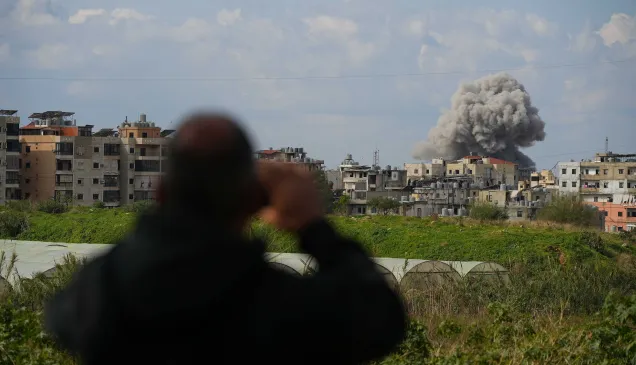
“It was 1:30 a.m. on a Sunday. We woke up to the sound of explosions. We grabbed our things and fled. I picked up the children and a few of our belongings.”
Since that night, Haitham has returned to his hometown only once.
“We found our homes gone. Every single home we knew was gone. There’s nowhere to stay now. There are no houses left. No electricity. No water,” he said, as he tried to warm his hands by the fire on a cold night in Beirut.
“This fire isn’t keeping us warm. Last time it rained, we were all wet,” he said.


The conflict that drove Haitham from his home in 2024 is repeating with horrifying familiarity.
“There’s no difference between this war and the last one,” he said, the weariness heavy in his voice.

Saada: A life shaped by displacement
In the sudden chaos of shelling, Saada had no time to think. She simply grabbed what she could and left her home. Still recovering from a surgery to her leg following a fall a few months before, and suffering from additional health complications, her situation is now exponentially more challenging.
“We were sitting at home when it started,” she recalled. “We rushed out, and everyone was already in the streets.”
The roads filled with fleeing families. Cars became stuck in the crowds as everyone searched for safety.

Now, unable to walk unaided or access the treatment she needs for her recovery, Saada shares a cramped space with her family. Days pass slowly. There is no work, no routine, only waiting.
“There’s nothing we can do,” she said. “We just sit and hope for something good.”
Displacement is not new to her. It is a pattern that has repeated throughout her life and across generations.
“It’s as if we were born into flight,” she said. “I fled, my children fled, and now their children are fleeing too.”


Daily life has become a series of small but barely surmountable challenges and Saada’s thoughts turn constantly to home.
“Home is where I felt at ease,” she says. “I could rest, eat, take a bath, watch TV,” she recalled.
“I hope everyone finds peace of mind. And that we can all go back to our homes - because that is where we belong.”

Farah: Managing family life amid displacement
Farah was asleep when the evacuation order came.
“It was around half past five in the morning,” she says. “They told us to evacuate immediately.”
There was no time to prepare. No time to think. She left her home in southern Lebanon without spare clothes, without documents, without any form of ID.
Farah and her family joined the stream of people fleeing along the road from Marjayoun. Without knowing where to go, they moved between towns before eventually finding shelter with relatives.

With two children, aged 11 and 13, navigating the daily challenges and anxieties of motherhood is a challenge in such difficult living conditions.
Her children are struggling to keep up with school. Classes have moved online, but learning is difficult when surrounded by noise, instability, and stress. “How are they supposed to study like this?” she asked.
Her son is already falling behind.
“He’s only just starting to read,” she said. “I’m really worried about him.”


Everyday life is defined by compromise. Electricity is scarce, phones are charged in the car, basic services are far away. Even a simple trip to the bathroom requires a drive.
Tensions between displaced families are rising too, as overcrowding and hardship take their toll.
“Everyone keeps their distance,” she explained. “It’s more peaceful that way.”
What she misses most is not just her house, but the life her family once had there.
“I miss my home so much,” she said. “I miss my things. I miss my freedom.”

Zaher: A life tied to the land, suddenly uprooted
Like many others, Zaher – a farmer from Marjayoun in Southern Lebanon - fled not knowing when, or if, he would return.

“I need to fetch some things from home, so I might have to go back. I don’t know when. I don’t know how,” he explained.
Before the fighting escalated, Zaher’s life revolved around his farm: tending olive trees, producing olive oil, and caring for his animals. Now, he said, that life feels far away.
When he fled, Zaher took his dogs with him: “I work with animals. I’m an animal lover,” he said.
“I’ve got three dogs here: they’re my life. I’ll do whatever it takes to keep them safe.”
Zaher turns to them for comfort, his companions through a life interrupted.


What troubles him most is the fear that this situation could become permanent. “That we’ll stay like this, that we’ll remain far from our homes… this horror.”
For Zaher, and for thousands like him, displacement is more than being uprooted. It is being cut off from a way of life and waiting, without answers, for it to begin again.

The very real human toll of displacement in conflict
For those forced to flee, displacement is about more than physically leaving a place.
As the stories of Zaher, Haitham, Saada and Farah show, it is about losing a sense of stability, routine and belonging. In conflicts around the world, this devastating reality repeats itself over and over again, affecting millions of families.
Behind every number reported on the news is a story like theirs - of lives interrupted, childhoods stolen, everything lost in an instant.